The Proven Framework for Off-the-Job Training Evidence
By Jevon Davies MBCS RITTech

A reliable off-the-job (OTJ) evidence framework records what learning took place, how it relates to the apprenticeship, when it happened and how many hours it took. Build those details into delivery from the start, then check the evidence against the standard’s required hours throughout the programme.
What counts as off-the-job training?
For apprenticeships in England, OTJ training is learning that takes place during the apprentice’s normal working hours, is directly relevant to their apprenticeship standard and teaches new knowledge, skills and behaviours (KSBs). It is not routine productive work or training provided solely to help someone perform their job.
The GOV.UK apprenticeship off-the-job training guidance, updated to align with the 2026 to 2027 funding rules, sets out four tests. An activity must:
- Teach new knowledge, skills or behaviours.
- Relate directly to the apprentice’s standard.
- Take place during normal working hours.
- Be an eligible learning activity, rather than an excluded activity such as initial assessment, a progress review or an examination.
Eligible learning can include theory, practical training, learning support, assignments and planned revision. The activity matters more than its location. A session at an employer’s premises may qualify if it is separate from productive duties and meets the tests. Applying a skill already taught during normal work does not automatically count as further OTJ training.
This distinction should be clear in the training plan and in each activity record. “Workplace learning” on its own is not enough to show what was taught or why it counts.
How many OTJ hours does your standard require?
The 2026 to 2027 apprenticeship funding rules and assessment plan guidance on GOV.UK was first published on 22 April 2026. Version 3 was published on 29 July 2026, and the GOV.UK page was updated on 3 August 2026. The rules apply to apprenticeships starting from 1 August 2026 to 31 July 2027.
Under version 3, references to Annex C were removed. Check the relevant standard on the Skills England apprenticeship search, where its minimum OTJ hours are published directly.
The rules set a programme-specific minimum. Apprentices must receive at least the published hours for their standard, unless the requirement is reduced on the basis of evidenced relevant prior learning. No programme may fall below 187 hours of evidenced delivery. Treat that as a firm floor, not as the target for every apprenticeship.
At enrolment and during programme reviews, confirm:
- The correct standard and version for the apprentice’s start date.
- The published minimum hours for that standard.
- Whether relevant prior learning supports a reduction.
- The planned hours recorded in the apprenticeship agreement, training plan and individualised learner record (ILR).
The planned figure should be consistent across these records at the start. The actual hours recorded on the ILR at the end of the practical learning period must be supported by delivery evidence.
What evidence do you need?
Use a consistent four-part record for each learning activity:
- Activity: What did the apprentice do? Describe the session, assignment, practical training or other eligible learning clearly.
- KSB link: Which parts of the standard did it address? Reference the relevant KSBs and explain the connection.
- Date and time: When did it take place? Record enough detail to show that it happened during normal working hours.
- Hours delivered: How long did the eligible learning take? Record the actual duration, not just the planned duration.
A useful record also identifies the apprentice and who delivered or confirmed the activity. Where an employer delivers training, the provider remains responsible for ensuring that it is evidenced. Agree with the employer in advance how attendance, duration and learning content will be recorded.
For example, a record stating “two hours of customer service training” leaves important gaps. It does not show when the activity happened, what was taught, how it linked to the standard or whether it took place during normal working hours. A stronger entry records the session date and time, its learning focus, relevant KSBs and actual hours.
GOV.UK guidance notes that electronic records are acceptable. The format is not prescribed, but the evidence must be quantifiable and support the OTJ definition. As well as evidence of individual activities, maintain a programme-level view of the total hours delivered.
How do you build OTJ evidence into delivery?
Evidence is more dependable when it is part of the teaching and review routine, rather than a separate exercise at the end of the programme.
Plan the curriculum against the standard. Map learning sessions and assignments to the relevant KSBs before delivery. Estimate the hours for each planned activity and identify who will deliver it. Record the delivery model and responsibilities in the training plan.
Capture delivery as it happens. Ask tutors and employers to record actual dates, times, activity details and duration promptly. If a session changes or is missed, update the record and re-plan the learning where needed.
Check progress regularly. Compare accumulated evidenced hours with the apprentice’s required total. Use scheduled reviews to spot missing records, delivery gaps or planned learning that has not happened. A progress review itself is not OTJ training, but it can be a useful time to resolve evidence issues.
Reconcile at the end of the practical period. Check that the total evidence supports the actual hours entered on the ILR. The end-point assessment (EPA) follows the practical learning period. Exams and other on-programme testing do not count as OTJ training under the GOV.UK guidance.
Digital learning can support a consistent delivery pattern when it is part of a planned programme. ExyonLearn is a course authoring platform with learner management tools built in, and it can work as a standalone learning environment. Its block-based editor includes more than 25 content block types and interactive components, which course authors can use to structure learning sessions around specified KSBs. The authored content can provide a consistent record of the learning material presented, but providers still need to record actual activity dates, times and eligible hours.
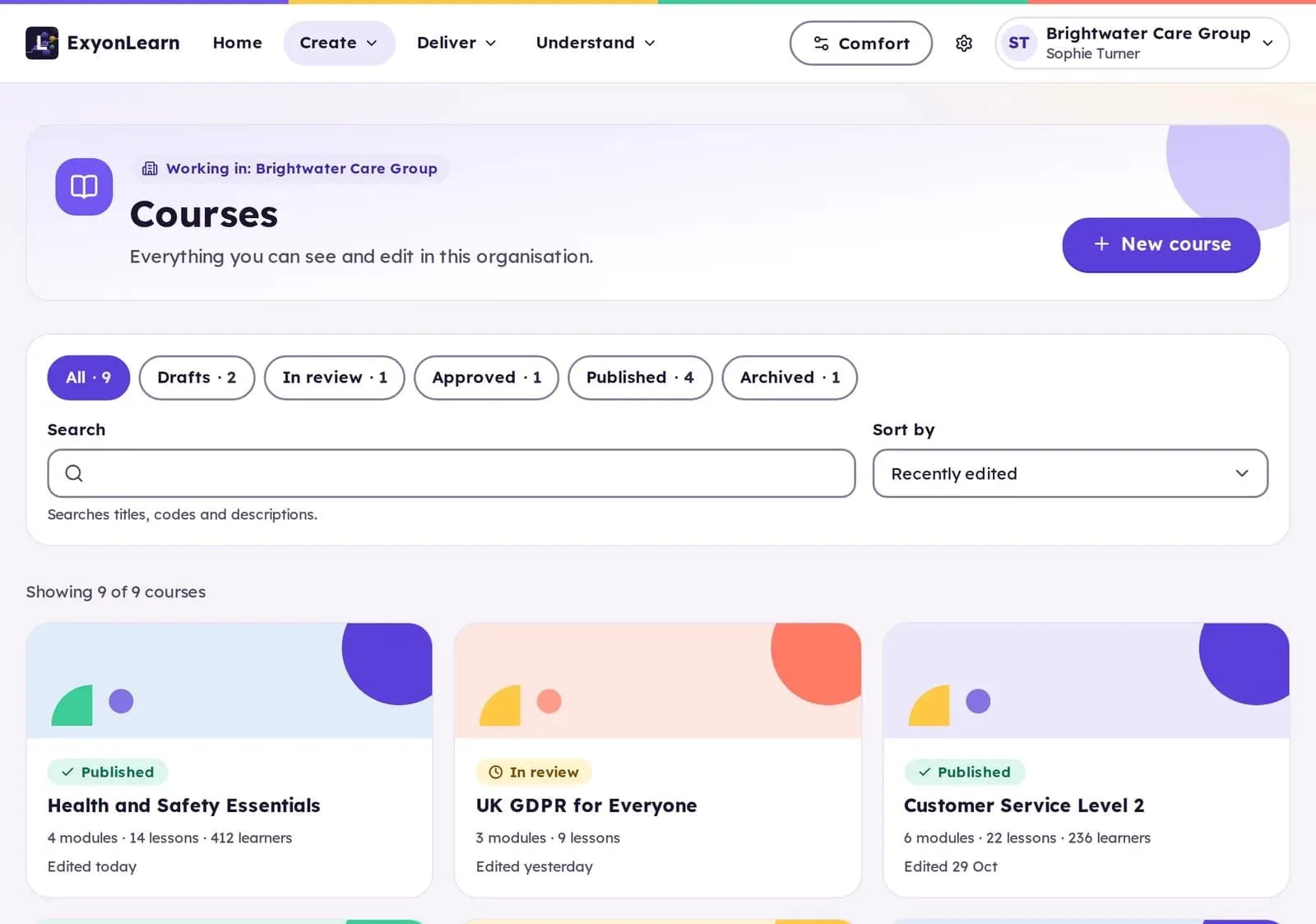
ExyonLearn can export courses to SCORM 1.2, SCORM 2004, xAPI or HTML for use with any SCORM or xAPI learning management system. Its reports support CSV and Excel export. These options can help providers organise learning delivery and review course data alongside their broader evidence processes.
For organisations building accessible learning, ExyonLearn is designed to WCAG 2.2 AA and fully conforms to WCAG 2.2 AA. It also offers learner themes with OpenDyslexic, Lexend and Atkinson fonts.
How do you evidence prior learning reductions?
A reduction in required hours needs a clear evidence trail. At initial assessment, identify relevant knowledge, skills and behaviours the apprentice already has, then record how that prior learning relates to the standard. Evidence may relate to previous education, training, qualifications or relevant work experience.
Document the assessment and its outcome. Show how the evidence supports the reduction, what learning remains necessary and how the reduced OTJ requirement was calculated. Keep the explanation alongside the apprentice’s plan and supporting records so that a reviewer can follow the decision.
Prior learning is not a general allowance to reduce hours. The reduction must reflect relevant, evidenced learning, and the resulting programme cannot fall below 187 hours of evidenced delivery. If the evidence does not support the proposed reduction, do not apply it.
How do you keep evidence in one place?
Scattered records make it harder to verify the full learning journey. Session notes may sit with tutors, attendance details with employers, assignments in a course platform and planned hours in the training plan. Agree one evidence process that connects these records to the apprentice and programme.
A practical evidence pack should bring together:
- The applicable standard and published minimum hours.
- The training plan and agreed planned hours.
- Prior learning evidence and any calculation of reduced hours.
- Activity records showing dates, times, learning content, KSB links and actual hours.
- An up-to-date running total and reconciliation against actual hours reported.
Where delivery involves an employer, agree responsibilities at the outset. Use a simple recurring process for employers to submit or confirm activity records. This reduces tutor chasing and makes missing information visible while it can still be resolved.
Pulse by Exyon Software is in development, not yet generally available; early access partners welcome. When Pulse launches, OTJ hours tracking will sit with Pulse. Courses will open from Pulse and learner progress will return to it. Pulse will be built to calculate ILR fields, with MIS overrides logged, and to report against the Ofsted framework. These planned capabilities do not guarantee an inspection grade, funding or audit outcome.
Make evidence part of programme delivery
The practical framework is straightforward: identify the correct minimum, plan learning against the standard, record each eligible activity with its KSB link, date, time and actual hours, then reconcile the total. Apply prior learning reductions only when the evidence supports them.
For independent training providers, this approach supports consistent delivery and gives tutors, compliance teams and employers a shared view of progress. Find out more about ExyonLearn course authoring and delivery, or explore how Exyon works with training providers and employers.
Book a demo to discuss your programme delivery needs.
Related articles
- Choosing Course Authoring for Apprenticeship Delivery
28 October 2026
Choose course authoring software for apprenticeship delivery that helps your team shape learning around the occupational standard, KSBs and employer needs.
- Who’s Pulling the Strings? Why "Job-Readiness" is the New Metric for Success
23 April 2026
Training providers face a growing focus on job-readiness and employment outcomes. See what that means for evidence, the ILR and working with your employers.
- Integrating Pre-Apprenticeship Content Into Programmes
18 November 2026
Independent training providers can prepare for pre-apprenticeship activity by building reusable foundation content that connects with existing vocational…
See it with your own programmes
Book a personalised walkthrough built around how your organisation funds, delivers and evidences training. No obligation.