Integrating Pre-Apprenticeship Content Into Programmes
By Jevon Davies MBCS RITTech
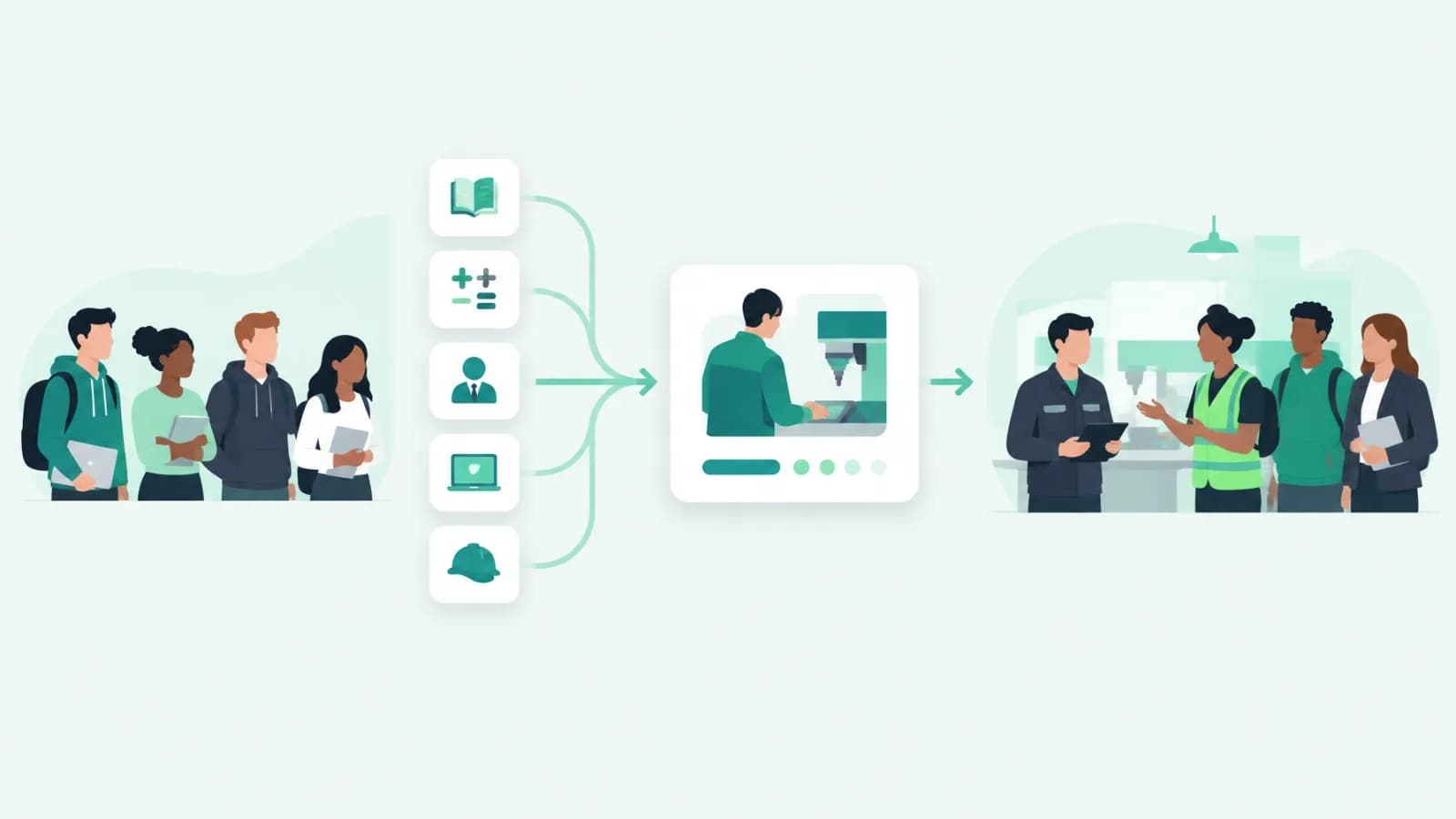
Independent training providers can prepare for pre-apprenticeship activity by building reusable foundation content that connects with existing vocational programmes. Keep the core material consistent, adapt it for each cohort and use it to prepare learners for the next step, rather than creating a separate course from scratch.
What is a pre-apprenticeship?
A pre-apprenticeship is a preparation route intended to help a learner move towards an apprenticeship or work. It combines English and maths, technical learning and employer work experience for young people who may need more qualifications, confidence or workplace familiarity before starting a full apprenticeship.
The Milburn review's final report, From a Welfare State to a Working State, published on GOV.UK on 17 November 2026, proposes an initial 25,000 pre-apprenticeship places. It also sets a path towards 270,000 under-25 apprenticeship starts a year by 2036, alongside wider expansion of further education for 18 to 24 year olds.
Those are recommendations to government, not funded policy. On the same day, the Department for Work and Pensions published its response, saying it agrees with the report's core principles and will set out a full response in a White Paper next year, with legislation to follow.
The report is specific about how that route would be built. It proposes adapting level 1 provision and the new level 2 Occupational Certificates into a single occupational route for study at 16 to 19, with colleges as the principal providers for 16 to 18 year olds and access continuing after 18. It also says young apprentices who have not yet secured level 2 English and maths should keep studying them alongside their apprenticeship, but that passing those exams should no longer be an exit requirement for completing one.
That detail matters for content planning. If preparation learning is built from level 1 and level 2 material, and English and maths becomes ongoing support rather than a gate, the same foundation content can serve a pre-apprenticeship cohort and an apprenticeship cohort without being rewritten.
If the recommendations are adopted, providers may need to connect preparation-stage learning with existing apprenticeships, T Levels and Higher Technical Qualifications (HTQs). Planning content that can be adapted across programmes gives teams a practical starting point, without assuming the final funding arrangements.
Why does pre-apprenticeship content matter now?
The interim report says nearly one million people aged 16 to 24 in the UK are not in education, employment or training. It also describes a weaker transition into work and fewer opportunities for young people to gain workplace experience.
Government commitments provide further context. In a Department for Education and Department for Work and Pensions press release on 22 June 2026, the government set out its Youth Guarantee and reforms to the Growth and Skills Levy, with the stated aim of supporting up to 500,000 opportunities to earn and learn. These commitments sit alongside the review's recommendations, which the government has said it is considering in full.
The interim report also records employers’ concerns that the levy is too inflexible. Employers said they would value being able to use funds for shorter courses, pastoral support, pre-apprenticeship activity or backfilling costs. On average, they reported spending around 42% of levy funds. For providers, this points to the value of planning flexible learning content while funding and programme arrangements remain unsettled.
How do you reuse content across programmes?
Start with a shared foundation that can sit alongside existing provision. Do not treat every preparation programme as a separate authoring project. Identify the learning that several routes need, then build it once and tailor it where the context changes.
A shared content base could include:
- English and maths support: practice using numbers, written instructions and workplace communication.
- Employability: preparation for interviews, applications, teamwork and receiving feedback.
- Digital skills: everyday use of workplace systems, online communication and safe handling of information.
- Sector tasters: short introductions to roles, tools, terminology and typical tasks.
Connect each item to a clear purpose in the next stage. For example, a communication activity might help learners prepare for a workplace placement and then reappear in a sector-specific apprenticeship context. Keep the foundation stable, while changing examples, tasks and sector detail.
A small content map can help authors and programme teams make those decisions. Record the reusable item, the programmes that use it, any cohort adjustments and the person responsible for reviewing it. This makes updates easier to manage and reduces the risk of similar lessons drifting apart.
How do you adapt content for new cohorts?
Reusing content does not mean giving every learner the same experience. Maintain a shared version of the core learning, then adapt its presentation and examples for the cohort, sector and starting point.
Consider adjustments such as:
- Reading level: use plain language, explain unfamiliar terms and provide a more supported version where needed.
- Sector context: change scenarios and examples to reflect the roles learners are considering.
- Learning sequence: divide complex topics into manageable steps and make the next activity clear.
- Support and timing: use tutor guidance and staged access to support different programme plans.
For a route leading into an apprenticeship, preparation content should complement technical training and employer experience, not replace them. Work with employers and tutors to identify what learners need to practise before a placement or programme begins. Then make the transition explicit, so learners understand how the preparation connects to the next stage.
Version control matters as content grows. Record what changed, why it changed and which programmes use each version. A shared authoring process with a second-person review can help subject experts maintain accuracy while keeping approval responsibilities clear.
How do you keep everything accessible?
Build accessibility into the source content rather than treating it as a final check. New cohorts may include learners with special educational needs and disabilities (SEND), as well as learners who benefit from different reading formats, pacing or ways to engage.
The Milburn interim report describes changes in the health needs reported among young people who are NEET. It notes that learning difficulties and autism are growing faster than mental health conditions as primary reported health conditions. It also cites the 2023 finding that almost a quarter of children aged 11 to 16 had a probable mental health disorder. These figures underline why preparation content should offer flexibility without making assumptions about any individual learner.
Use clear headings, readable layouts, meaningful image descriptions and a range of content formats. Offer choices that let learners adjust text size, spacing, colours or font. Make activities understandable without relying on colour or one mode of interaction alone.
ExyonLearn is designed to WCAG 2.2 AA and fully conforms to WCAG 2.2 AA. Its pre-publication accessibility checks block publishing when must-fix issues remain. Learners can also choose themes and fonts including OpenDyslexic, Lexend and Atkinson.
How do you manage content and delivery at scale?
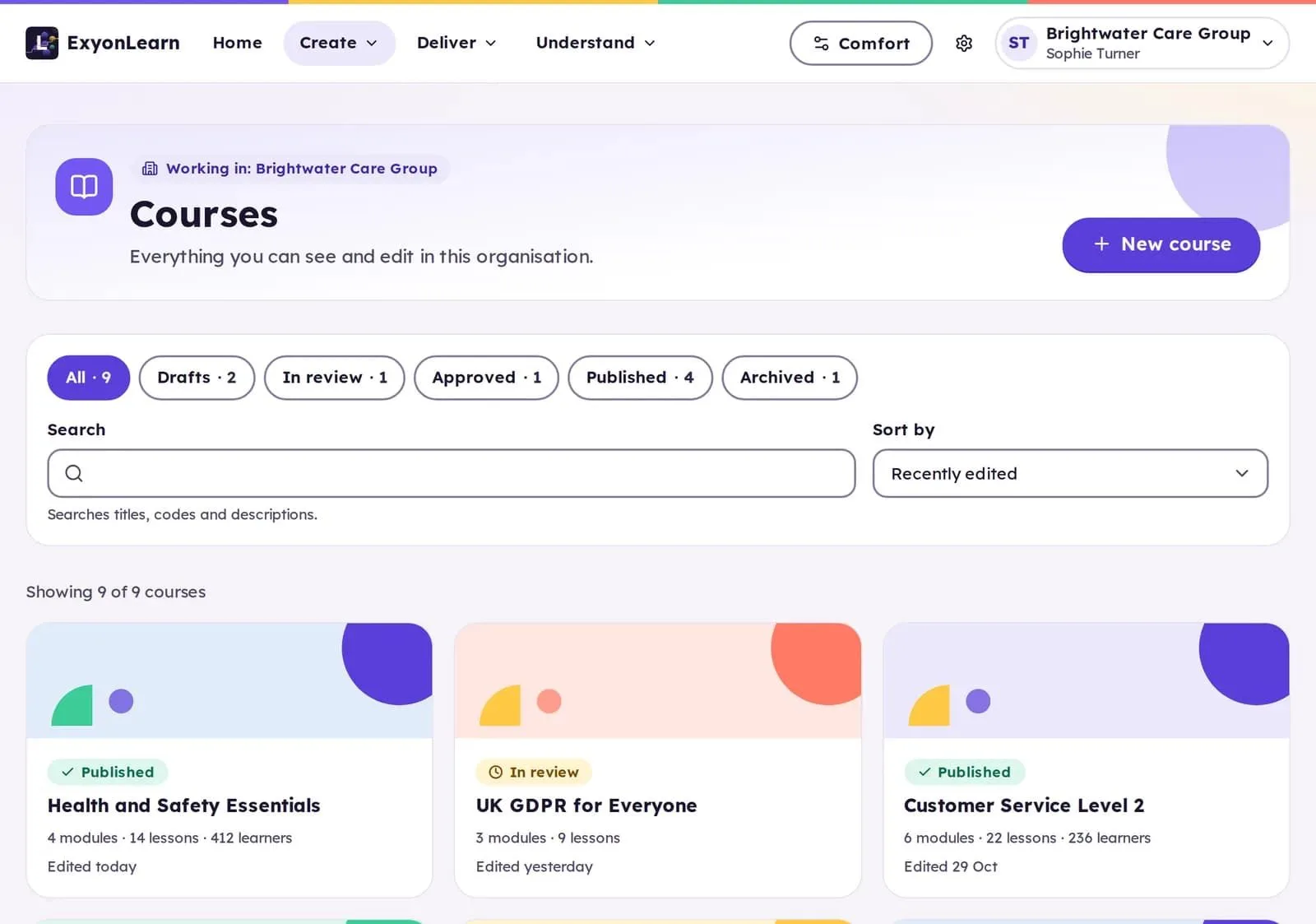
A shared content base needs clear ownership and practical controls. As programmes expand, agree who can edit, review and approve content, and set a process for updating material when employer expectations or programme requirements change.
For example, teams can use:
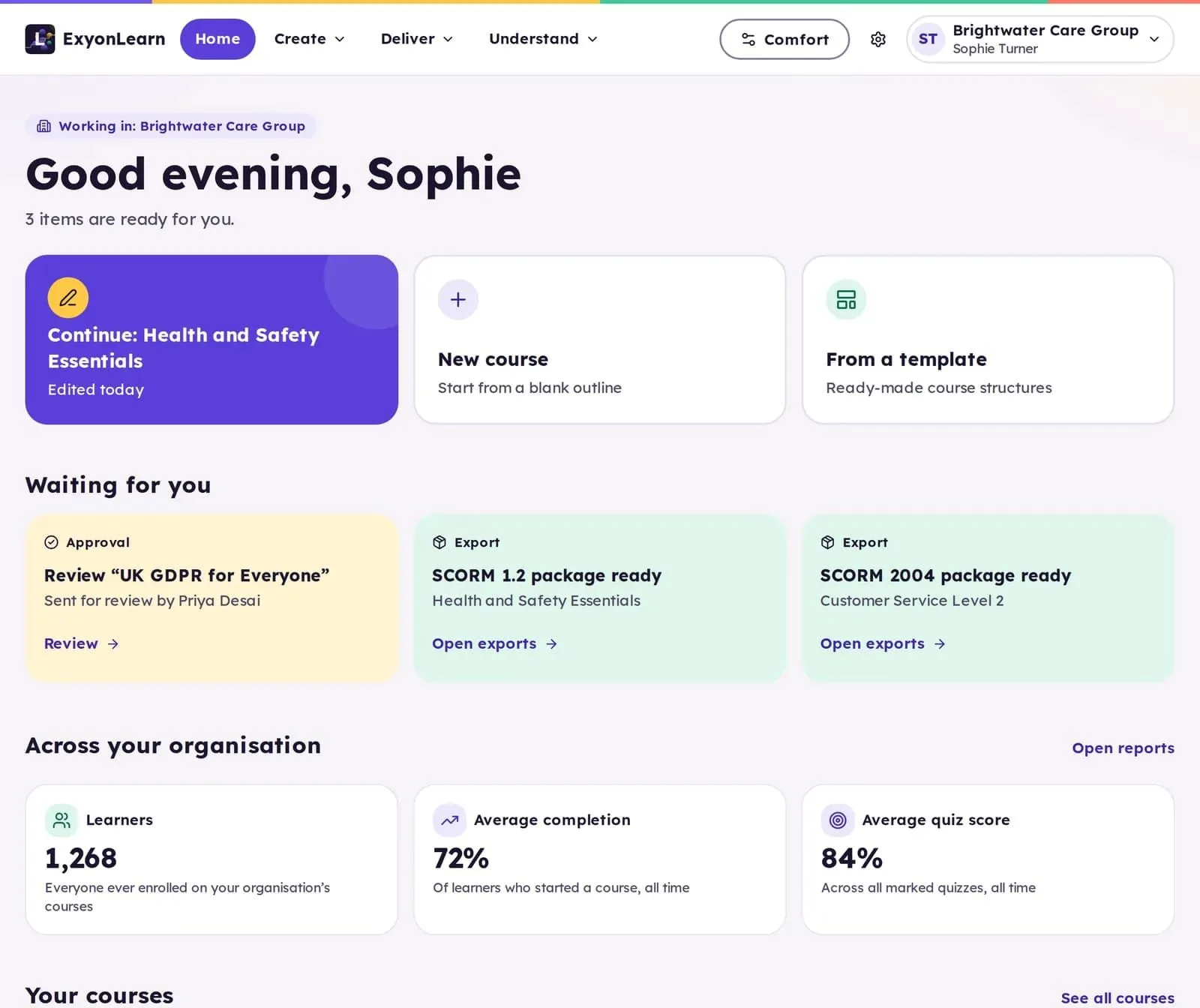
- Reusable templates: save courses as templates and adapt them for new programmes.
- Review and approval: require a second person to sign off before publishing. Nobody can approve their own edits.
- Controlled access: unlock content by date, completion, days after enrolment, minimum score or manually.
- Learner organisation: use groups and tutors, with bulk upload for learner administration.
- Progress reporting: export reports to CSV or Excel to review activity and progress.
These controls support a consistent authoring process across apprenticeship, T Level and HTQ provision. They also help teams see which content is used, who has reviewed it and where learners are in a programme. They do not replace provider judgement, employer input or required programme records.
How can the content fit your existing learning systems?
ExyonLearn includes learner management tools, so it can be used on its own to author and deliver courses. If your organisation uses another learning management system (LMS), export courses in SCORM 1.2, SCORM 2004, xAPI or HTML for use with any SCORM or xAPI LMS. Exported packages retain the course theme and fonts.
Explore ExyonLearn to see how its authoring and delivery capabilities could support a shared content base. Learn about Exyon’s support for training providers for more on the provider context.
Pulse by Exyon Software is in development, not yet generally available; early access partners welcome. When Pulse launches, learners will launch from Pulse straight into the course, signed in securely, and progress will flow back automatically.
What should providers do next?
Start with the programmes already in delivery. Identify the foundation content that could serve more than one route, agree how it will be maintained and choose one area to adapt for different cohorts. Keep the policy position clear: pre-apprenticeship places are a recommendation in the final report, not funded provision, and the funding, delivery and timing are still to be confirmed by government.
This approach gives an authoring team a practical way to prepare. Reuse what is relevant, tailor what needs to change and keep accessibility and review part of the process from the beginning.
Book a demo to discuss how ExyonLearn could support reusable preparation content across your programmes.
Related articles
- Milburn Report: Five Steps for Training Providers
18 November 2026
Training providers can prepare now by checking programme capacity, building reusable learning content, reviewing accessibility, strengthening employer…
- The Proven Framework for Off-the-Job Training Evidence
12 November 2026
A reliable off-the-job (OTJ) evidence framework records what learning took place, how it relates to the apprenticeship, when it happened and how many hours it…
- How AI Quiz Generation Speeds Up Course Authoring
10 November 2026
AI quiz generation speeds up course authoring by producing draft questions from lesson content, giving authors a starting point they can review and edit…
See it with your own programmes
Book a personalised walkthrough built around how your organisation funds, delivers and evidences training. No obligation.